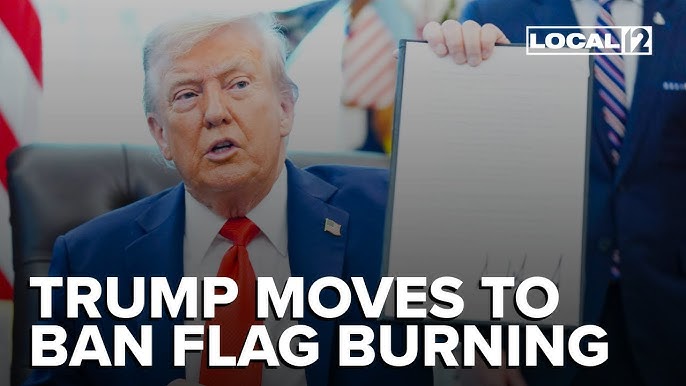

President Trump’s New Executive Order: A Controversial Move on Flag Burning
The recent executive order signed by President Donald Trump has sparked a heated debate. This order mandates that the Justice Department investigate and prosecute instances of flag burning if the act is deemed likely to incite imminent lawless action or amounts to “fighting words.” While some see this decision as a straightforward measure to protect national symbols, others view it as a challenge to established constitutional protections. In this editorial, we take a closer look at the order, explore its legal background, and discuss the broader social and political implications.
Understanding the Order
In a move that surprised many, President Trump signed the executive order in the Oval Office, directing the Department of Justice to examine cases where the American flag is burned. With the order in place, anyone engaging in such activity could face up to one year in jail—a stark statement from a president who has long been vocal about his disdain for flag burning.
On the surface, the order appears straightforward: burn the flag, and you face punishment. However, the underlying claim is more complicated, as it makes a distinction between ordinary flag burning and acts that “incite imminent lawless action” or become “fighting words.” This distinction is crucial and forms the core of the ongoing debate over the balance between protecting national symbols and safeguarding constitutional free speech rights.
Historical Background: The 1989 Supreme Court Decision
To understand the gravity of Trump’s decision, it is essential to look back at the landmark Supreme Court case from 1989. In that tense and controversial decision, the justices ruled narrowly, 5-4, that flag burning is a form of political expression that the First Amendment protects. This ruling has been the cornerstone of debates on free speech and protest ever since.
Some important aspects of the 1989 case include:
- The ruling affirmed that even actions many find offensive may still be protected if they fall under expressive activity.
- It highlighted the importance of resisting attempts to undermine constitutional rights, no matter how provocative the expression.
- The decision underscored that the government must tread carefully when regulating speech or symbolic acts.
Despite this clear judicial stance, President Trump’s new order questions whether the protection afforded by the First Amendment should extend to flag burning when it is argued to incite violence or panic. This introduces tangled issues that complicate simple notions of free speech.
Examining the Constitutional Perspective on Free Expression
The order directly calls into question the established interpretations of the First Amendment, particularly regarding what constitutes protected speech. A lawyer from a free speech advocacy group commented that while people can be prosecuted for setting a fire in unauthorized areas, the government cannot target expressive activities that are constitutionally safeguarded—even if many find them deeply offensive.
This reaction from civil liberties advocates hones in on several tricky parts of constitutional law:
- How does one legally differentiate between symbolic acts that might incite violence and those that are merely expressive?
- What are the fine points that separate simple protest from actions deemed to be “fighting words?”
- Where does one draw the line between protecting national symbols and upholding free speech?
Legal experts warn that if we start criminalizing such expressive actions, it might set a precarious precedent—one where political speech is stifled in the name of public order. The executive order’s language, although targeting extreme interpretations of flag burning, risks muddying the legal waters, making it difficult for courts to adjudicate where the acceptable boundary lies.
The Role of the Justice Department and the Attorney General
One of the critical components of Trump’s order is the call for Attorney General Pam Bondi to take swift legal action. The directive is clear: vigorously enforce criminal and civil laws against flag burning that causes harm beyond the protected expression.
This plan places a lot of responsibility on the Department of Justice to figure a path through the tangled issues of expression and incitement. The order even directs that, in cases involving foreign nationals, there should be severe immigration-related consequences such as visa revocations, deportation, or interference with naturalization processes.
In practice, the executive order would require the Justice Department to:
| Action | Implication |
|---|---|
| Investigate instances where flag burning may incite violence | Scrutinize behavior to determine the threshold of incitement |
| Prosecute offenders if the act crosses constitutional limits | Impose penalties, such as jail time, for actions that meet the criteria |
| Challenge previous Supreme Court rulings | Attempt to bring the issue back to a judicial setting with a more conservative court |
| Enforce immigration consequences | Disrupt visas, residency, and naturalization for foreign nationals involved in flag burning deemed criminal |
This list illustrates the multifaceted nature of the order and highlights the nerve-racking challenges that lie ahead for law enforcement and the legal system. Critics argue that this directive, while aiming to protect national symbols, risks undermining the very expressive rights that form a cornerstone of American democracy.
Flag Burning: Symbolism and National Identity
The American flag has long been a powerful symbol of national pride and unity. For many citizens, the flag is not merely a piece of fabric but a representation of shared heritage, freedom, and sacrifice. In this sense, the act of burning the flag carries with it a deep emotional charge and a potent message of dissent.
However, it is important to appreciate the subtle details behind such symbolic actions. While some may see flag burning as nothing more than a harmless form of protest, others view it as a direct attack on national unity. This divergence of opinion leads to small distinctions that are often at the heart of heated debates.
Supporters of the executive order suggest that burning the flag goes beyond symbolic expression—it is a provocative act categorically different from other forms of protest because it can trigger widespread backlash and potentially incite violent reactions. They argue that such actions are not just politically inaccurate but dangerously inflammatory.
On the other hand, constitutional purists maintain that even such emotionally charged acts must be protected as free speech under the First Amendment. They insist that once the government starts curbing expression on the basis of its offensiveness, it ventures on a slippery slope toward broader censorship.
Balancing Free Speech and Public Safety
At the center of the debate is the challenge of balancing the right to free expression with the need to preserve public safety. This is a recurring theme in debates on constitutional rights and law enforcement. The executive order implies that flag burning, when it stokes public disorder, can be criminalized without violating free speech protections.
This position raises several complicated pieces of discussion:
- The Risk of Overreach: If government authorities are permitted to assess the intent behind symbolic speech, there is a risk of subjective enforcement and political misuse.
- Defining Incitement: Establishing clear criteria for what constitutes “inciting imminent lawless action” is tricky, and the blurred line between harsh protest and criminal incitement can create tension between various legal interpretations.
- Impact on Political Dissent: There remains a genuine concern that such legal measures could be exploited to silence political dissent, thereby undermining the foundational democratic principles of open debate.
When we take a closer look at the debate, it is evident that we are not merely talking about law enforcement but a fundamental inquiry into how America defines and limits its democratic freedoms. The executive order forces us to explore whether societal safety can ever be prioritized without compromising cherished civil liberties.
Political Rhetoric and Judicial Review
Another essential aspect of this debate involves the intersection of political rhetoric and judicial review. President Trump’s order explicitly aims to challenge a decades-old Supreme Court decision by calling on the Attorney General to pursue litigation that may place this issue back before the justices. With a gravitation toward more conservative rulings in the current Supreme Court, Trump anticipates a favorable environment for reinterpreting the law.
This strategy, however, is rife with problematic twists and turns:
- Political Influence: The attempt to use executive power to reshape constitutional law raises concerns about politicizing the judicial system.
- Judicial Independence: Shifting the legal framework on such a sensitive matter risks undermining the principle of independent judicial review that is central to American jurisprudence.
- Long-Term Impact: If successful, the reexamination of established precedent could have far-reaching implications beyond the confines of flag burning, potentially affecting numerous forms of protected speech.
Critics argue that turning this issue into a political battleground may not only distort the intended meaning of the First Amendment but also set a dangerous precedent whereby future administrations might use similar tactics to target unpopular forms of expression.
Public Reaction and Societal Implications
The president’s call to criminalize flag burning—even in cases that might not meet the narrow criteria of incitement—has evoked a mixed reaction among the public. While some citizens echo Trump’s sentiments, arguing that the act is disrespectful and disruptive, others fear that it will lead to unnecessary curtailment of free speech.
As citizens weigh in on the matter, several social issues come to light:
- Emotional Response: For many, the flag is a source of pride and a central element of national identity. Any attack on its sanctity generates strong emotional responses.
- Fear of Government Overreach: There is an understandable concern that targeting symbolic actions might be the first step toward a broader crackdown on protest and political dissent.
- Public Safety Concerns: Proponents of the order stress that, in situations where flag burning is accompanied by violent protests or disturbances, the state must be empowered to act decisively.
The divide in public sentiment points to a broader societal conflict: should national symbols be protected at all costs, or is it more essential to allow even the most provocative forms of expression to stand as a testament to liberty, however controversial they might be?
International Perspectives on Flag Burning and National Symbols
This debate is not confined to American borders. Around the world, the burning of national symbols is treated with varying degrees of seriousness depending on cultural and legal contexts. In some countries, such acts are met with strict penalties, while in others, they are regarded as permissible forms of dissent.
The current order also extends its impact beyond the national citizenry. Particularly for foreign nationals, the executive order lays out severe immigration consequences. These include potential revocation of visas, cancellation of residency permits, and even the possibility of deportation. This aspect of the order reflects a desire to ensure that the respect for national symbols extends to all present within the country.
Such international implications highlight several key points:
- Global Standards vs. National Priorities: How do American legal standards align with global trends in handling freedom of expression and national symbolism?
- Immigration Enforcement: Foreign nationals involved in acts of flag burning may face punitive immigration actions, blurring the line between domestic policy and international law.
- Cultural Sensitivity: The treatment of national symbols can carry different weights in various cultures, and imposing a blanket policy might not be well received on an international scale.
This intersection between immigration and free speech enforcement is a reminder that policies enacted at a national level can have ripple effects far beyond domestic boundaries.
The Debate Over Symbolism and Patriotism
At the heart of the controversy is the symbolic meaning of the American flag. To many, the flag encapsulates the struggles, aspirations, and values of an entire nation. Its desecration is seen not as a mere act of protest, but as a statement of deep-seated contempt and hostility toward the political union and its shared values.
However, there exists a significant debate over whether the act of burning the flag should be penalized, considering that symbolic gestures are a form of political speech. This debate features some complicated pieces:
- Symbol versus Substance: While the flag serves as a potent symbol, some argue that the real issues lie in the concrete policies and tangible actions that affect citizens’ lives.
- Expression of Dissatisfaction: For many, burning the flag is not about denouncing patriotism but expressing profound discontent with the status quo and a call for change.
- The Role of Provocation in Politics: Provocative acts have historically served as sparks in movements calling for progress, even when they upset established norms.
It is essential to recognize that debating the seriousness of flag burning involves digging into the subtle details of patriotism, dissent, and the evolving standards of public protest. What may seem like an overly dramatic measure to some could be interpreted as a call to honor the symbols that bind a nation together among others.
Challenges in Enforcing the Order
The practical enforcement of the executive order presents its own set of challenges. Law enforcement agencies must now figure a path through a maze of legal and constitutional issues that are anything but straightforward. Officers are tasked with identifying when a symbolic act crosses the line into behavior that poses a genuine threat to public order.
A closer look at the operational challenges includes:
- Assessing Intent: Determining if flag burning is intended to incite violent behavior or if it represents a form of political speech is a nerve-racking process fraught with subjective judgments.
- Legal Ambiguity: The language of the executive order, with its references to “imminent lawless action” and “fighting words,” leaves room for multiple interpretations that could lead to inconsistent enforcement.
- Resource Allocation: Ensuring that law enforcement agencies have the time and resources to thoroughly investigate each incident is a serious undertaking, especially in times of heightened political tension.
The table below summarizes some of the key challenges that law enforcement may face:
| Challenge | Details |
|---|---|
| Intent Analysis | Distinguishing between expressive protest and incitement to violence requires careful examination of context and motivation. |
| Legal Interpretation | Ambiguities in the order’s language may result in varying interpretations and potential legal disputes. |
| Resource Limitations | Agencies must operate within limited resources while managing increased enforcement demands. |
| Political Pressure | Enforcement actions may be subject to political scrutiny or accusations of bias. |
This mix of legal and operational challenges underscores why many critics argue that the issue is not as straightforward as it might seem at first glance. The practical implementation of the order could very well be as tangled as the debates that have emerged in its wake.
The Broader Implications for American Democracy
Beyond the legal technicalities and enforcement challenges, Trump’s executive order raises significant questions about the nature of American democracy. At its core, this debate touches upon the delicate balance between security and the freedoms that have helped define the nation since its founding.
Key considerations in this broader debate include:
- Preservation vs. Protection: How does one protect a cherished national symbol without infringing on essential rights like free speech?
- Political Division: In an already polarized political climate, actions perceived as limiting political expression may further intensify tensions rather than heal divides.
- Role of Leadership: The executive order places the president in a position to challenge long-standing judicial principles, provoking fundamental questions about the separation of powers and the role of elected officials in shaping constitutional law.
Critics assert that decisions like these should be left to the courts rather than being dictated by the political winds of the moment. They warn that such measures, if taken further, risk transforming the American legal landscape in ways that could erode trust in democratic institutions.
Public Safety or Silencing Dissent?
A recurring theme in political discourse is the question: when does protecting public safety become a pretext for stifling dissent? President Trump has argued that flag burning leads to riots and violent behavior, claiming that “you burn a flag, you get one year in jail” and implying that such measures will restore order. However, this approach has its critics who contend that the connection between a symbolic act and public safety is neither clear nor direct.
Several points deserve consideration here:
- Exaggeration of Threat: There is little evidence to prove that increasing prosecutions for flag burning will deter violence or disorder on a broad scale. Critics say that other factors contribute far more to violent outbreaks than symbolic gestures.
- Differences in Perspective: While some view the act as a dangerous spark that leads to chaos, others see it as a misguided expression of political frustration—a view that demands thoughtful dialogue rather than immediate criminalization.
- Impact on Political Protest: Overzealous enforcement might discourage robust political debate, sending a chilling message to activists and dissidents who fear that any form of protest could have severe legal repercussions.
This debate over balancing public safety and free speech stares us in the face as a microcosm of larger challenges in modern governance. It forces us to consider whether measures intended to foster safety might also inadvertently quell the vibrant exchange of ideas that fuels democratic progress.
Balancing Enforcement With Fundamental Rights
Enforcing the new order in a manner that respects individual rights and avoids overreach is a task laden with subtle parts and hidden complexities. The government must find a way to safeguard public order without undermining the core principles that protect dissent.
Some measures that could be considered include:
- Clear Guidelines: Developing operational protocols that meticulously outline when flag burning crosses the line into criminal conduct can help law enforcement steer through ambiguous situations.
- Judicial Oversight: Robust judicial review can act as an essential safeguard to ensure that any prosecutions are in strict accordance with constitutional standards.
- Transparency and Accountability: Maintaining transparent records of enforcement actions and decisions can help build trust and mitigate accusations of political bias.
- Public Dialogue: Engaging with civil society and legal experts in ongoing public dialogue can help refine laws and policies in a manner that respects both security and free expression.
By considering these implementable steps, policymakers can attempt to address the tricky parts and tangled issues inherent in legislating symbolic acts. However, the ultimate challenge remains: how do we protect our national identity without trampling on the very rights that define a free society?
Future Considerations: The Path Ahead for Flag-Related Legislation
Looking forward, the discussion on flag burning legislation is likely to remain on edge as the interplay between tradition and modernity evolves. This executive order might well be the precursor to a broader movement aiming to redefine how symbolic acts are treated in the legal context.
Some forward-thinking considerations include:
- Legal Reforms: Legislators and judges may need to revisit and revise existing laws to address the little twists in interpreting acts of protest and expression in a way that is relevant to today’s political and social landscape.
- Educational Outreach: Public education initiatives can help citizens understand the finer shades of constitutional rights and the legal reasoning behind both protective measures and free speech guarantees.
- Community Engagement: Building forums for dialogue between government, legal experts, and community leaders can ease tensions and build consensus on what symbolic acts mean to different segments of society.
- International Comparisons: Studying how other democracies handle the prosecution of symbolic acts can provide insights into creating balanced legal frameworks that respect both tradition and freedom.
Policy decisions of this nature rarely exist in isolation. They are part of a broader trend where governments are forced to grapple with the challenge of reconciling age-old values with modern-day methods of advocacy and protest. Even if one views the order as a necessary step toward maintaining national decorum, it remains loaded (with issues) and subject to intense debate in legal, political, and social circles.
Reflections on Constitutional Interpretations and Judicial Power
This entire episode also invites us to reflect on the role of the Supreme Court and its decisions in shaping public policy. The 1989 ruling that protects flag burning as a form of political expression is more than a legal decision; it is a part of the fabric of American freedom. As Trump openly criticizes that decision and attempts to reintroduce the issue into the judicial arena, the debate inevitably centers on whether political figures should be allowed to alter or challenge established constitutional interpretations.
Some reflections on this include:
- The Weight of Precedent: Longstanding judicial decisions carry a weight intended to prevent capricious changes in the law. Overturning such rulings is not merely a matter of political will, but requires careful and measured judicial scrutiny.
- Separation of Powers: The executive branch’s attempt to directly challenge the Supreme Court’s ruling blurs the lines between branches of government, raising questions about the independence of judicial review.
- Long-Standing Debate: The conversation about what constitutes protected speech versus criminal incitement is as old as the Republic itself, and every new legal challenge adds another layer to this ongoing dialogue.
These reflections demonstrate that the debate over Trump’s executive order is not limited to the details of flag burning alone—it touches upon the core values and operational mechanisms of American democracy.
Conclusion: Striking a Balance Between National Pride and Individual Freedom
In closing, President Trump’s executive order represents more than just an attempt to curb flag burning; it is emblematic of the larger struggle to balance national pride with individual freedoms. The order challenges a decades-old Supreme Court decision, and in doing so, reopens a contentious debate over the boundaries of constitutional protection for political expression.
For supporters, the order is a necessary act to maintain the respect and dignity of a national symbol revered by millions. For opponents, it signals a dangerous move toward government overreach—a move that could chill free speech and undermine the essential principles of a democratic society.
As the legal consequences of this order begin to unfold, we are left with a nerve-racking question: How do we protect the symbols that unite us while ensuring that the freedom to protest—even in its most provocative forms—remains intact? The answer will require lawmakers, judges, and citizens alike to take a closer look at the limits of government power, the scope of free expression, and the values that define our national identity.
The coming months and years will undoubtedly see a deepening of this debate. Whether through further legal challenges, legislative reforms, or ongoing public discourse, the issue of flag burning in America is set to remain a flashpoint in the broader conversation about the delicate balance between safeguarding national symbols and protecting the individual rights that are the hallmark of a free society.
Ultimately, it is imperative that as a society, we recognize and navigate the tricky parts and tangled issues raised by this controversy with care. Only by working through these complicated pieces of dialogue—balancing security concerns with the must-have freedoms guaranteed by our Constitution—can we hope to find a solution that preserves both our national identity and our commitment to individual liberty.
In an era where symbolic gestures continue to spark profound public debate, this episode stands as a reminder that, in the end, defending our democratic values requires that we remain ever vigilant against any encroachments on the rights that define us. The path ahead is not simple, and it is loaded (with issues) that need to be addressed in a manner that is both thoughtful and respectful of our shared heritage.
As the legal battles and public debates intensify, citizens and policymakers must remember that the strength of American democracy lies not in the suppression of controversial expressions, but in the robust dialogue that allows for even the most contentious issues to be aired and examined under the light of justice and reason. In this light, the executive order on flag burning serves as a catalyst for a broader debate—a debate that challenges us to work through the small distinctions and subtle details that ensure the balance between national pride and the fundamental right to free speech remains resilient in the face of change.
Originally Post From https://kstp.com/kstp-news/top-news/trump-moves-to-ban-flag-burning-despite-supreme-court-ruling-that-constitution-allows-it/
Read more about this topic at
FIRST AMENDMENT: FREE SPEECH AND FLAG BURNING
Trump orders crackdown on US flag burning and …
